What is a motherboard chipset, and how to find which one you have
The chipset decides how many SSDs, USB ports and PCIe cards your board can run, not how fast your CPU is. Here's what it does, how Intel and AMD chipsets compare in 2026, and four ways to see which one you have.

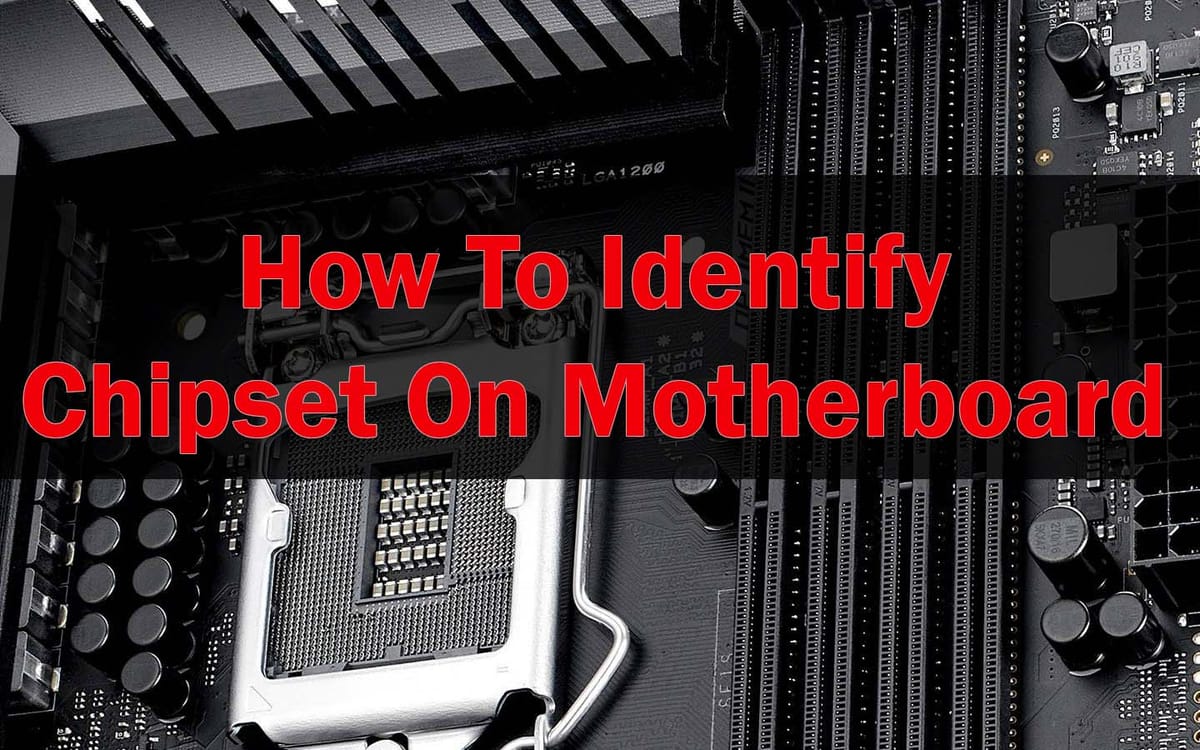
Most people look up their chipset for one of two reasons: they want to know if a new CPU, SSD or GPU will work, or a driver download page is asking for it.
Both come down to the same idea. The chipset does not make your processor faster. It decides how much your motherboard can connect: how many M.2 SSDs, how many fast USB ports, whether you can overclock, and whether that second PCIe slot gets real bandwidth.
What is a motherboard chipset?
A motherboard chipset is a controller chip on the motherboard that connects the CPU to everything the CPU doesn't handle directly: extra M.2 and SATA drives, most USB ports, network and Wi-Fi chips, audio, and secondary PCIe slots. It's usually under a small flat heatsink near the bottom right of the board.
On Intel boards it's called the PCH (Platform Controller Hub). On AMD AM5 boards the chipset is one or two Promontory chips, often just called "the chipset".
A useful way to picture it: the CPU has a small number of direct, fast lanes, and the chipset is a hub that shares one link to the CPU among many slower devices.
What the chipset does and doesn't control
Modern CPUs do most of the important work themselves. Memory, the main graphics slot and usually the first M.2 SSD are wired straight to the processor. As ASUS explains in its PCIe lane guide, data from chipset lanes takes an extra hop to reach the CPU.
| Connected to the CPU | Connected through the chipset |
|---|---|
| RAM | Second, third, fourth M.2 slot |
| Main x16 graphics slot | SATA ports |
| First (sometimes second) M.2 slot | Most USB ports |
| A few USB ports on some platforms | 2.5G/5G Ethernet, Wi-Fi |
| Extra PCIe x1/x4 slots |
What the chipset decides in practice:
- how many M.2 SSDs and SATA drives you can run at full speed
- how many USB ports, and how fast (10 Gbps, 20 Gbps, USB4)
- whether CPU overclocking is allowed (Intel Z-series, AMD B and X-series)
- how many extra PCIe lanes are left for capture cards, NICs or HBAs
- sometimes, whether a slot gets disabled when you fill another one
What it does not decide: game FPS, CPU speed, or which CPUs fit. The socket decides compatibility, and the BIOS version decides whether a newer CPU boots.
Intel and AMD chipsets in 2026
The letter in the chipset name tells you the tier. For current desktop platforms:
| Platform | Chipset | Tier | Notes |
|---|---|---|---|
| Intel LGA1851 (Core Ultra 200) | Z890 | High end | CPU overclocking, most PCIe lanes |
| B860 | Mainstream | No CPU overclocking, fewer chipset lanes | |
| H810 | Budget | Basic, very few extra lanes | |
| AMD AM5 (Ryzen 7000/8000/9000) | X870E | High end | Two chipset chips, USB4, PCIe 5.0 graphics and M.2 |
| X870 | Upper mid | One chip, USB4 and PCIe 5.0 graphics guaranteed | |
| B850 | Mainstream | CPU overclocking, PCIe 5.0 M.2 | |
| B840 | Budget | No CPU overclocking, PCIe 3.0/4.0 only | |
| A620 | Budget | No CPU overclocking, limited I/O |
Older boards still in use follow the same pattern: Intel Z790/B760 (LGA1700) and AMD X670E/X670/B650E/B650 (AM5) or X570/B550/A520 (AM4).
Intel's next platform, Nova Lake (Core Ultra 400), moves to a new LGA1954 socket with 900-series chipsets such as Z990 and Z970. According to Tom's Hardware, retail availability is expected in early 2027, so those boards need new CPUs and won't take current Core Ultra 200 chips.
My rule when buying: pick the cheapest chipset that has enough M.2 slots and USB for what you'll actually plug in. On AM5, a good B850 board is enough for most gaming and homelab builds. X870E only pays off when you're filling several fast SSDs and expansion cards at the same time.
How to find which chipset you have
The chipset is rarely printed in plain text in Windows. The reliable path is: find the exact motherboard model first, then look up that model's spec page. Most board names include the chipset anyway (for example "B650 AORUS ELITE" or "PRO Z790-A").
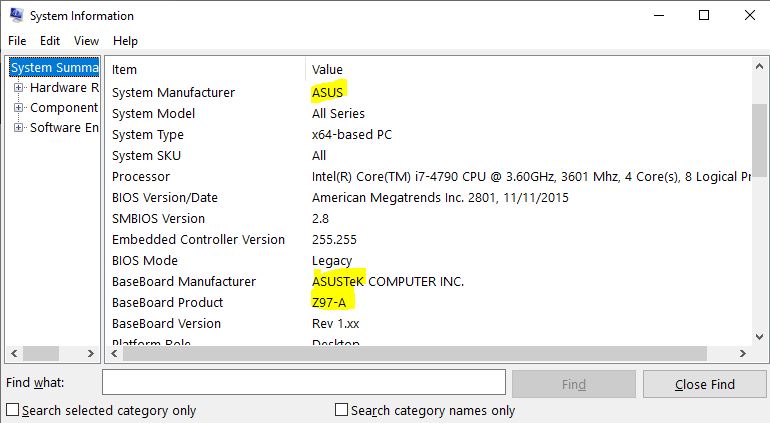
1. Windows: System Information (no tools needed)
Press Win + R, type msinfo32, press Enter. Look at BaseBoard Manufacturer and BaseBoard Product. The product name usually contains the chipset.
2. Windows: PowerShell
The old wmic baseboard command no longer works: Microsoft removed the WMIC tool from current Windows 11 versions. Use PowerShell instead:
Get-CimInstance Win32_BaseBoard | Select-Object Manufacturer, Product, Version
To see the chipset devices Windows has detected, list them by name:
Get-PnpDevice -Class System | Where-Object FriendlyName -match 'Chipset|LPC|eSPI|SMBus|PCH' | Select-Object FriendlyName
On Intel systems this often shows the chipset directly, as something like Intel(R) Z790 LPC/eSPI Controller. On AMD systems you'll mostly see generic names like AMD SMBus, so go back to the board model.
If you just need the board model, I covered more ways in how to check your motherboard model from the command prompt.
3. Windows: CPU-Z
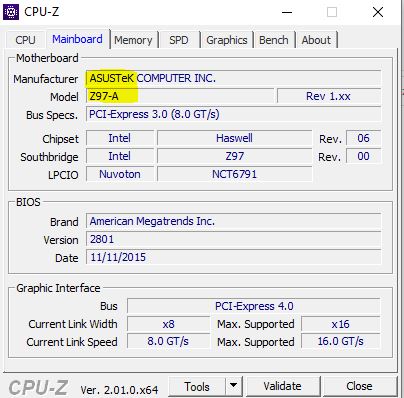
The free CPU-Z utility shows the chipset on its Mainboard tab, in the Chipset and Southbridge rows, along with the board model.
4. Linux: lspci and dmidecode
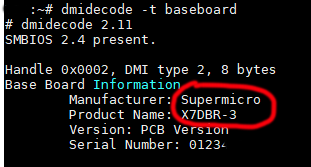
Get the board model:
sudo dmidecode -t baseboard | grep -E 'Manufacturer|Product Name'
Then look for the chipset controllers on the PCI bus:
lspci | grep -iE 'isa bridge|lpc|smbus|chipset'
On Intel the ISA bridge line usually names the PCH, something like ISA bridge: Intel Corporation Z790 Chipset LPC/eSPI Controller. On AMD AM5 boards the Promontory parts often appear as 600 Series Chipset even on 800-series boards, because AMD reused the same chip. The board model from dmidecode is the tie-breaker.
5. The board itself or the BIOS
If the PC won't boot into an OS, the model name is printed on the board, usually between the PCIe slots or near the RAM slots, and it's on the box. The BIOS main screen also shows the board model on most boards.
When the chipset actually matters
These are the situations where knowing your chipset saves you money or a wasted weekend.
Adding an NVMe SSD. The chipset decides how many M.2 slots exist and whether one of them shares lanes with a SATA port or a PCIe slot. Check the manual's lane-sharing table before buying.
Overclocking. Intel needs a Z-series chipset and a K or KF CPU. On AMD, B850, X870 and X870E allow it, while B840 and A620 don't.
A second GPU, HBA or 10G NIC. Extra x4 or x8 slots usually hang off the chipset and share its single link to the CPU. That's fine for a NIC, but tight for several fast SSDs at once.
Virtualization and homelab. IOMMU groups depend partly on the chipset, so if you plan PCIe passthrough in Proxmox, check how the board groups its slots. Also make sure virtualization is on in the BIOS. Here's how on Gigabyte and Aorus boards.
Drivers. On Windows, install the chipset driver from AMD or Intel (or the board maker's support page) after a clean install. Windows Update covers the basics, but the vendor package is the complete set.
My take
Don't pay for a chipset tier you won't use. For most builds, the chipset question is really "how many SSDs and USB devices will I connect in the next three years?" Count them, check the board manual's lane-sharing table, and buy the cheapest board that fits.
And if you only need to know what's in your current PC, msinfo32 or one PowerShell line gets you the board model in under a minute. The chipset is almost always right there in the name.
FAQ
What does a motherboard chipset do?
It connects the CPU to devices the CPU doesn't drive directly: extra M.2 and SATA drives, most USB ports, networking, audio and secondary PCIe slots. It also decides features such as CPU overclocking and how many high-speed ports the board can offer.
Does the chipset affect gaming performance?
Barely. The graphics card and the main M.2 SSD connect straight to the CPU, so FPS doesn't change between chipsets. The chipset matters for features and expansion, not frame rates.
Is the chipset the same as the CPU socket?
No. The socket (AM5, LGA1851) decides which CPUs physically fit. Several chipsets share one socket: an AM5 CPU works on A620, B650, B850, X870 or X870E boards, though a newer CPU may need a BIOS update.
How do I check my chipset without opening the PC?
On Windows, run msinfo32 and read BaseBoard Product, or run Get-CimInstance Win32_BaseBoard in PowerShell. On Linux, run sudo dmidecode -t baseboard and lspci | grep -i lpc. The chipset is usually part of the board model name.
Can I upgrade the chipset?
No. The chipset is soldered to the motherboard. Getting a different chipset means replacing the board.